


























Options trading for beginners comes down to one idea: options let you control 100 shares of a stock for a fraction of the price, and they can also lose 100% of what you paid in days. This guide teaches you how options work, how to place your first trade, and which five strategies make sense for beginners. Every section links to a deeper guide when you’re ready for more.
Key takeaways
- An option is a contract that gives you the right, not the obligation, to buy or sell 100 shares at a set price before a set date.
- Calls profit when a stock rises; puts profit when it falls.
- When you buy an option, the most you can lose is the premium you paid, and many options do expire worthless.
- The safest first strategies are covered calls, cash-secured puts and defined-risk spreads.
- Paper trade for at least a few weeks before risking real money.
Disclosure: This guide is for education only and is not investment advice. Options involve risk and are not suitable for all investors. Some links below are affiliate links; stockmaven.com may earn a commission at no cost to you.
What Is an Option? (The 60-Second Version)
An option is a contract that gives you the right, but not the obligation, to buy or sell 100 shares of a stock at a fixed price before a fixed date. You pay for that right up front. The price you pay is called the premium.
Think of it like a deposit on a house. You pay $5,000 to lock in a $400,000 price for 60 days. If the neighbourhood booms and the house is suddenly worth $450,000, your deposit just became very valuable. If prices fall, you walk away and lose only the $5,000.
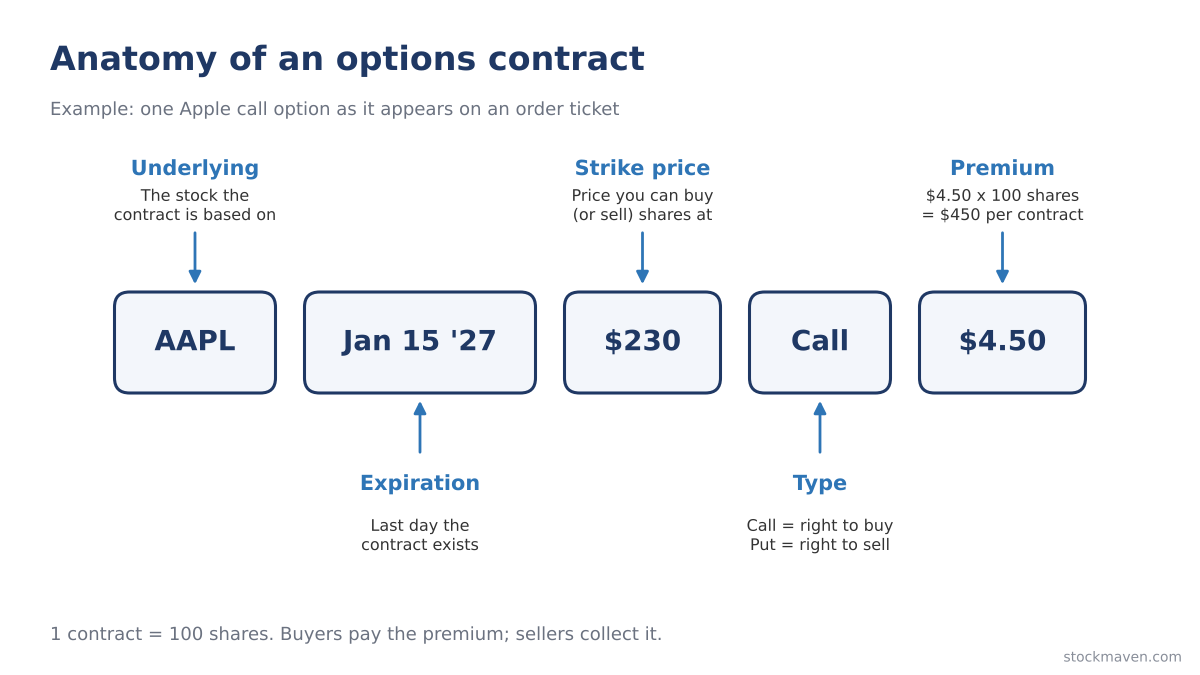
Options work the same way. Every option has four parts:
- Underlying: the stock or ETF the contract is based on, such as AAPL or SPY.
- Strike price: the fixed price at which you can buy or sell the shares.
- Expiration date: the last day the contract exists. After that, it’s gone.
- Premium: the price of the contract, quoted per share. One contract covers 100 shares, so a $2.50 premium costs $250.
Options are called derivatives because their value comes from, or derives from, the price of something else. When the stock moves, the option’s price moves too, often by a much larger percentage. That’s the leverage that attracts traders, and the reason losses can come fast.
You can do two things with an option: buy it or sell it. Buyers pay the premium and get the right. Sellers (also called writers) collect the premium and take on the obligation. A buyer’s risk is limited to the premium. A seller’s risk depends on the strategy, and for some trades it is very large.
There are only two types of options: calls and puts. Every strategy in this guide, from a simple covered call to the wheel, is built from those two pieces.
New to stocks too? Start with our stock trading for beginners guide, then come back here.
Calls vs Puts
A call is a bet that the stock goes up. A put is a bet that it goes down. Buyers of each pay a premium; sellers of each collect it.
| Call option | Put option | |
|---|---|---|
| Gives the buyer the right to… | Buy 100 shares at the strike | Sell 100 shares at the strike |
| Buyer profits when… | Stock rises above strike + premium | Stock falls below strike − premium |
| Buyer’s maximum loss | Premium paid | Premium paid |
| Seller’s obligation | Sell 100 shares at the strike if assigned | Buy 100 shares at the strike if assigned |
| Common beginner use | Bullish bet with limited risk; covered calls for income | Portfolio insurance; cash-secured puts to buy stock cheaper |
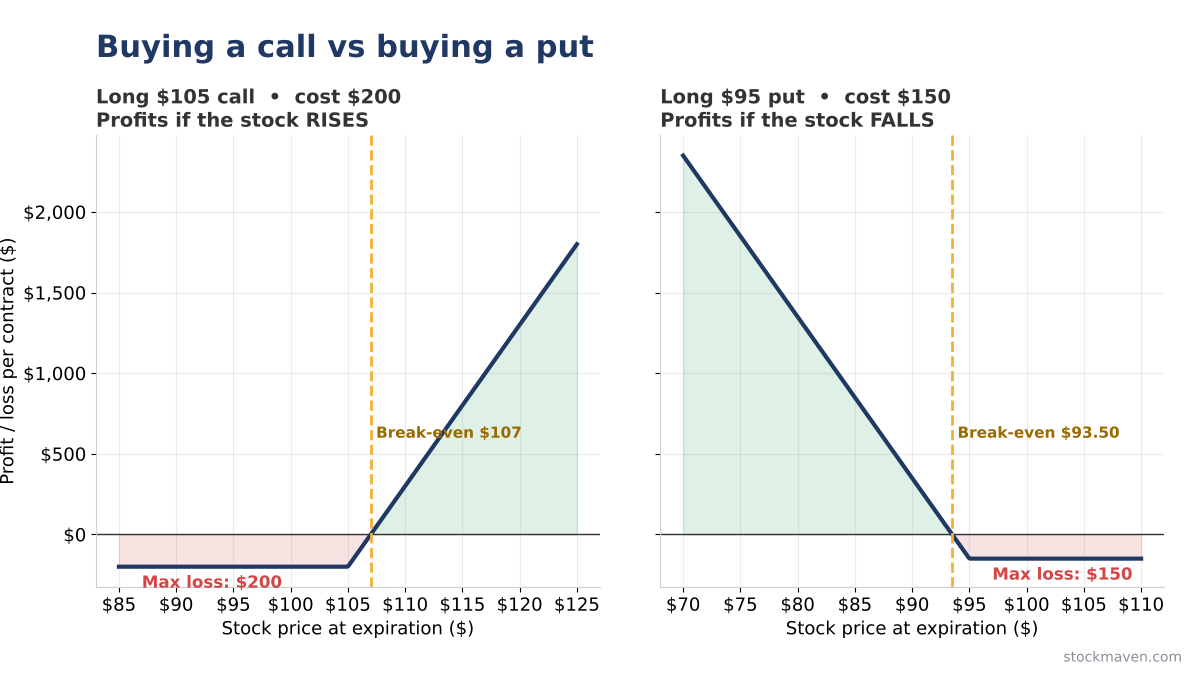
Call example. A stock trades at $100. You buy one $105 call expiring in 45 days for $2.00, which costs $200. Your break-even is $107 ($105 strike + $2 premium). If the stock is at $115 at expiration, the call is worth $10, or $1,000, for an $800 profit. If the stock stays below $105, the call expires worthless and you lose $200.
Put example. You own 100 shares of the same $100 stock and worry about a drop. You buy one $95 put for $1.50 ($150). If the stock crashes to $80, your put is worth $15 ($1,500), offsetting most of the loss below $95. If the stock rises instead, you lose the $150, the cost of the insurance. This is called a protective put; learn more in what is hedging in stocks.
Moneyness: ITM, ATM and OTM
Traders describe where the strike sits versus the stock price:
- In the money (ITM): the option has real value now. A call whose strike is below the stock price, or a put whose strike is above it.
- At the money (ATM): the strike is at or very near the stock price.
- Out of the money (OTM): the option has no exercise value yet, only time value. Cheap OTM options are tempting, but most expire worthless.
For a deeper walkthrough with more examples, read call and put options explained.
How to Read an Options Chain
An options chain is the table your broker shows with every available strike and expiration for a stock. Calls usually sit on the left, puts on the right, and strikes run down the middle.
Here’s a simplified call-side chain for Anthropic (ANT), which began trading on Nasdaq on November 19, 2026. The numbers are illustrative for a stock trading near $95, not live quotes.
| Strike | Bid | Ask | Last | Volume | Open interest | Implied vol. |
|---|---|---|---|---|---|---|
| $90 (ITM) | $9.80 | $10.20 | $10.00 | 4,210 | 6,800 | 78% |
| $95 (ATM) | $6.90 | $7.20 | $7.05 | 9,560 | 12,400 | 76% |
| $100 (OTM) | $4.70 | $4.95 | $4.80 | 11,300 | 15,900 | 75% |
| $110 (OTM) | $2.05 | $2.25 | $2.10 | 7,850 | 10,200 | 77% |
What each column means:
- Strike: the price at which the option lets you buy (calls) or sell (puts).
- Bid / Ask: the highest price a buyer will pay and the lowest a seller will accept. You usually buy near the ask and sell near the bid.
- Last: the price of the most recent trade. It can be stale, so trust bid/ask instead.
- Volume: contracts traded today. See what is volume in stocks for the same idea in shares.
- Open interest: contracts still open from earlier days. High open interest means a liquid, actively used strike.
- Implied volatility (IV): how big a move the market is pricing in. New IPOs like ANT typically carry very high IV, which makes their options expensive.
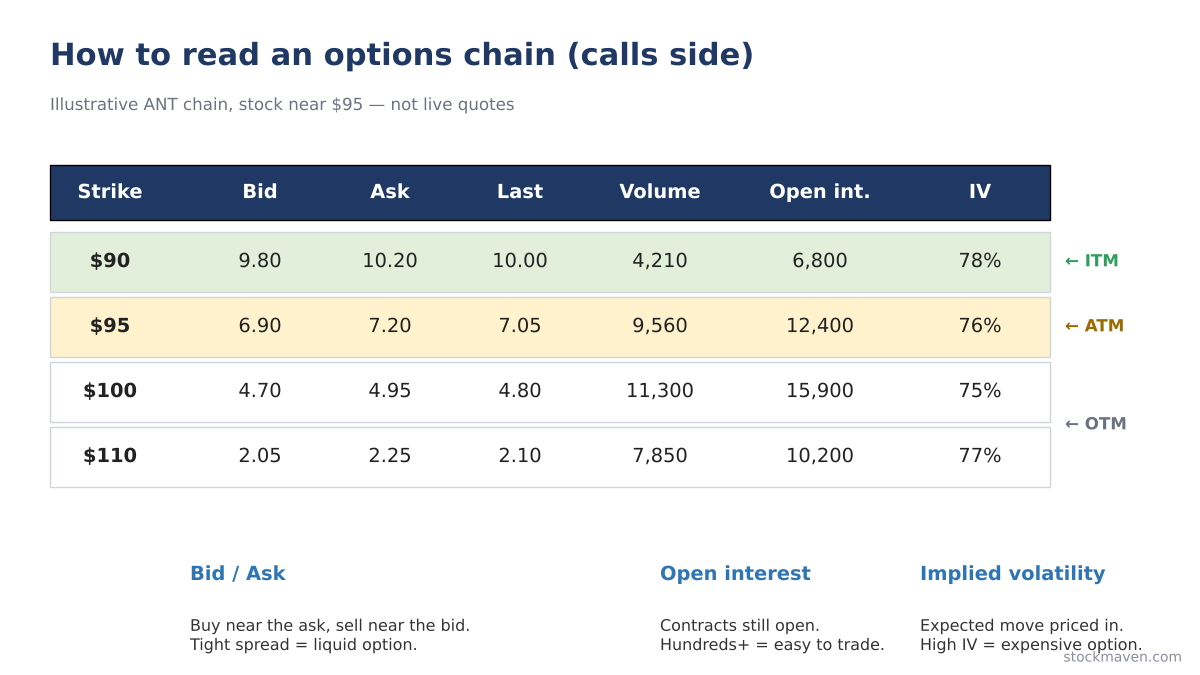
Two liquidity rules for beginners: pick strikes where the bid-ask spread is under about 5–10% of the option price, and where open interest is in the hundreds or more. Wide spreads quietly cost you money every time you enter and exit.
Our full walkthrough, how to read an options chain, adds annotated screenshots. Want to see it on a real app? Read how to buy an option on Webull.
The Greeks in Plain English
The Greeks are numbers that tell you how an option’s price will change when something else changes: the stock price, time, or volatility. Your broker calculates them for you. You only need to know what each one means.
| Greek | Measures | Plain-English meaning | Example |
|---|---|---|---|
| Delta | Sensitivity to the stock price | How much the option moves per $1 move in the stock | Delta 0.50 → option gains about $0.50 ($50 per contract) if the stock rises $1 |
| Gamma | How fast delta changes | The “acceleration” of your position | High gamma near expiration makes options swing wildly |
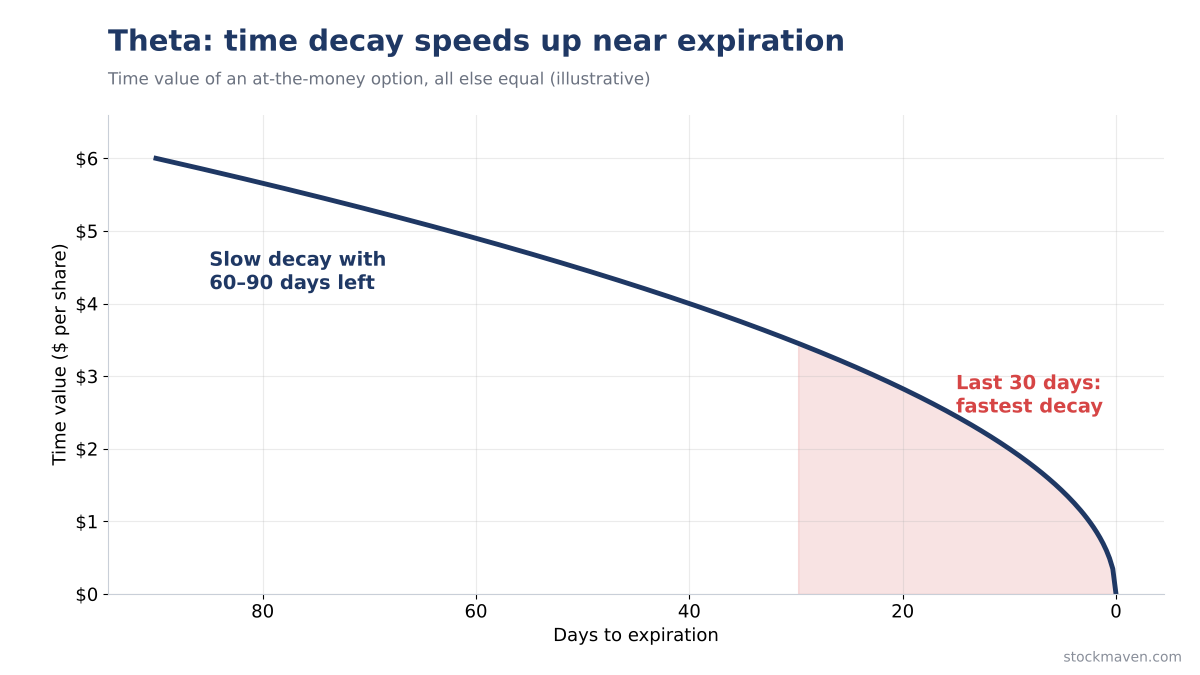
| Theta | Time decay | How much value the option loses each day, all else equal | Theta −0.08 → option loses about $8 per contract per day |
| Vega | Sensitivity to implied volatility | How much the option moves per 1-point change in IV | Vega 0.15 → option gains $15 per contract if IV rises 1 point |
One trade, four Greeks. Say you buy the $100 ANT call from the chain above for $4.80. It might show delta 0.42, gamma 0.03, theta −0.09 and vega 0.14. That tells you:
- If ANT rises $1 tomorrow, the call gains about $0.42.
- After that move, delta climbs toward 0.45 because of gamma, so the next dollar helps a little more.
- If ANT goes nowhere, the call loses about $0.09 a day to time decay.
- If the market calms down and IV drops 5 points, the call loses about $0.70, even if the stock doesn’t move.
That last point surprises many beginners. You can be right about direction and still lose money if volatility falls or time runs out.
Buyers vs sellers. Option buyers fight theta every day; option sellers collect it. That’s why income strategies like covered calls are built around selling, and why buying cheap short-dated options is so hard to win.
Go deeper with our dedicated guides: what is gamma in options, what is theta in options, and the full options Greeks explained cheat sheet.
How to Get Approved to Trade Options
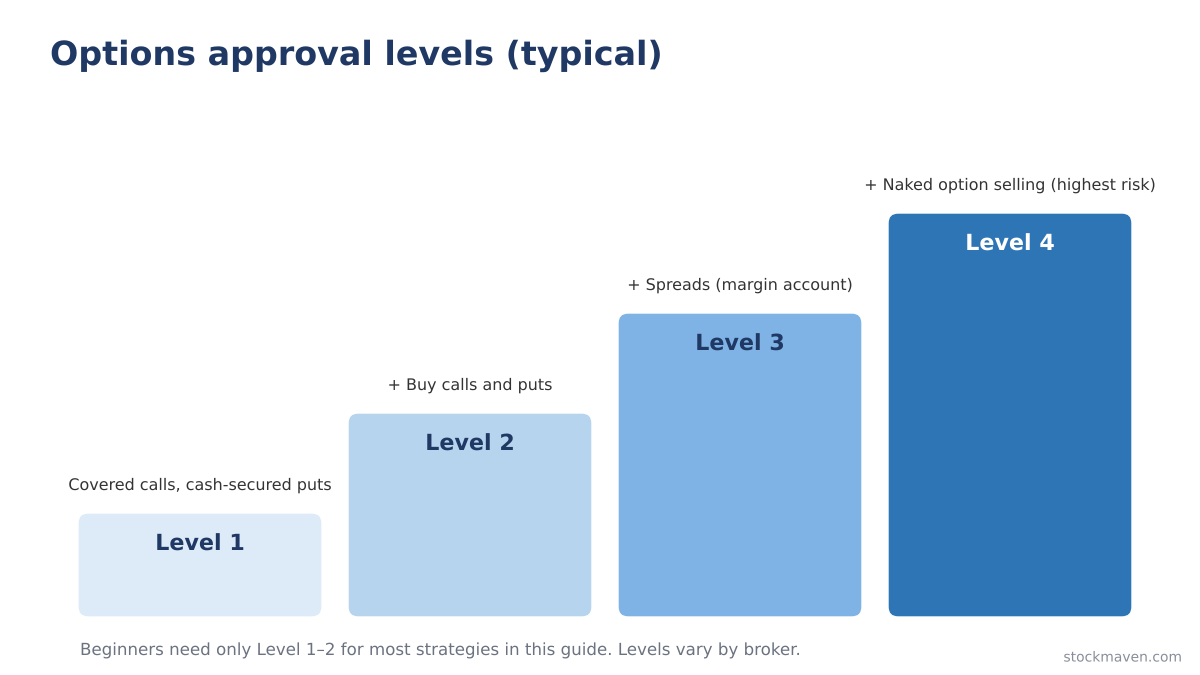
You can’t trade options the moment you open a brokerage account. You first apply for an options approval level, and the broker decides which strategies you may use. Each broker numbers its levels a little differently, but most follow this pattern:
| Level | Typical strategies allowed | Account type |
|---|---|---|
| Level 1 | Covered calls, cash-secured puts | Cash or margin |
| Level 2 | Everything in Level 1 + buying calls and puts | Cash or margin |
| Level 3 | + Spreads (verticals, iron condors) | Margin |
| Level 4 | + Selling naked (uncovered) options | Margin, higher equity |
On the application, brokers usually ask about:
- Your annual income, net worth and liquid net worth
- Your investment objective (income, growth, speculation)
- Years of experience with stocks and options, and trades per year
- Whether you understand that options can expire worthless
Answer honestly. These rules exist to keep beginners out of trades that can lose more than the account holds. Overstating your experience to unlock naked options is a fast way to get hurt.
Most beginners get Level 1 or 2 quickly, and that’s all you need for the first four strategies in this guide. Spreads (Level 3) usually require a margin account. If you’re denied, add a few months of stock trading history and reapply.
Our step-by-step guide to options approval levels walks through the Webull application screen by screen. Already approved? Jump to how to trade options on Webull.
Choosing an Options Broker
The right first broker is the one that makes options easy to understand and cheap to practise with. Look for four things:
- Low per-contract fees. Many brokers now charge $0 commission on options, but regulatory and per-contract fees still apply. Small fees add up when you trade often.
- Paper trading. A simulated account lets you practise with fake money on real market data. This is the single most useful beginner feature.
- Clear options tools. Look for a readable chain, a profit/loss chart before you place the trade, and Greeks displayed by default.
- Fair approval process. Some brokers approve Level 2 quickly; others are stricter.
| Broker | Best for | Why beginners like it |
|---|---|---|
| Webull | Mobile-first beginners | Clean options chain, built-in paper trading, no commission on stock options |
| tastytrade | Learning to trade options seriously | Built by options traders; strong education and strategy tools |
| Robinhood | Absolute simplicity | Very simple interface; easy to place a first trade |
| moomoo | Research-heavy beginners | Detailed data, options analytics and paper trading |
| Interactive Brokers | Growing into advanced trading | Broad market access and professional-grade tools |
Fees and promotions change often, so check each broker’s current pricing page before you sign up.
On a laptop, a second screen makes reading chains much easier; see our best laptop for stock trading picks. For the full ranking with fees, approval rules and screenshots, read best options trading platforms for beginners.
Options Trading for Beginners: Your First Trade, Step by Step
Your first trade should be small, simple and practised on paper first. Here’s the exact process, using Webull as the example. Other brokers follow nearly the same steps.
Phase 1: Practise on paper (2–4 weeks)
- Turn on paper trading. In Webull, open the menu and choose Paper Trading. Our guide on how to paper trade on Webull shows each screen, and what is paper trading on Webull explains the limits.
- Pick one liquid stock or ETF. SPY, QQQ, AAPL or MSFT all have tight bid-ask spreads and heavy open interest.
- Place 10–20 practice trades. Buy a call, buy a put, sell a covered call. Watch how delta and theta change the price day by day.
- Keep a trade journal. Write down why you entered, your exit plan, and what actually happened.
Phase 2: Your first real trade
- Decide your view and timeframe. Example: “I think AAPL rises over the next six weeks.”
- Choose an expiration 30–60 days out. Longer-dated options lose value to time decay more slowly than weekly options, giving your idea room to work.
- Choose a strike. For a first long call, a slightly in-the-money or at-the-money strike (delta 0.50–0.70) behaves more like the stock and is less likely to expire worthless than a cheap OTM strike.
- Check liquidity. Bid-ask spread under about $0.10–$0.20 and open interest in the hundreds or more.
- Size it small. Risk no more than 1–2% of your account on the premium. On a $5,000 account, that’s $50–$100 at risk, which may mean a spread instead of a single call.
- Use a limit order at the mid-price. Never use a market order on options; wide spreads can fill you at a bad price. Step up a few cents if it doesn’t fill.
- Set your exit plan before you click buy. For example: take profit at +50%, cut the loss at −50%, and close at least a week before expiration regardless.
- Review the order screen. Confirm the ticker, call vs put, strike, expiration, quantity (1 contract = 100 shares) and total cost.
The detailed walkthrough with screenshots is in how to trade options on Webull. If you want a safety net on any stock position you hold, our guide on how to set a stop loss on Webull covers that side.
Pre-trade checklist: ☐ I know my max loss ☐ I know my break-even ☐ I have an exit plan ☐ The spread is tight ☐ This trade is under 2% of my account.
5 Options Strategies for Beginners
These five strategies cover almost everything a beginner needs: betting on a rise, protecting against a fall, earning income, and limiting risk. Each one below includes a worked example with round numbers so you can follow the math. All examples ignore fees.
| Strategy | Your outlook | Max loss | Max gain | Typical approval level |
|---|---|---|---|---|
| Long call | Bullish | Premium paid | Unlimited | Level 2 |
| Long put | Bearish / hedge | Premium paid | Large (stock to $0) | Level 2 |
| Covered call | Neutral to mildly bullish | Stock falling (offset by premium) | Premium + gain up to strike | Level 1 |
| Cash-secured put | Neutral to bullish; want to own the stock | Strike − premium (stock to $0) | Premium | Level 1 |
| Vertical spread | Bullish or bearish, defined risk | Net debit paid | Spread width − debit | Level 3 |
1. Long call: a limited-risk bet that a stock rises
Buying a call gives you upside exposure to 100 shares for much less money than buying the shares outright. Your loss is capped at the premium.
Example. A stock trades at $50. You buy the $50 call expiring in 45 days for $3.00, which costs $300.
- Break-even at expiration: $53 ($50 strike + $3 premium).
- If the stock rises to $60: the call is worth at least $10 ($1,000). Profit: $700, a 233% return on $300.
- If the stock stays at $50 or falls: the call expires worthless. Loss: $300.
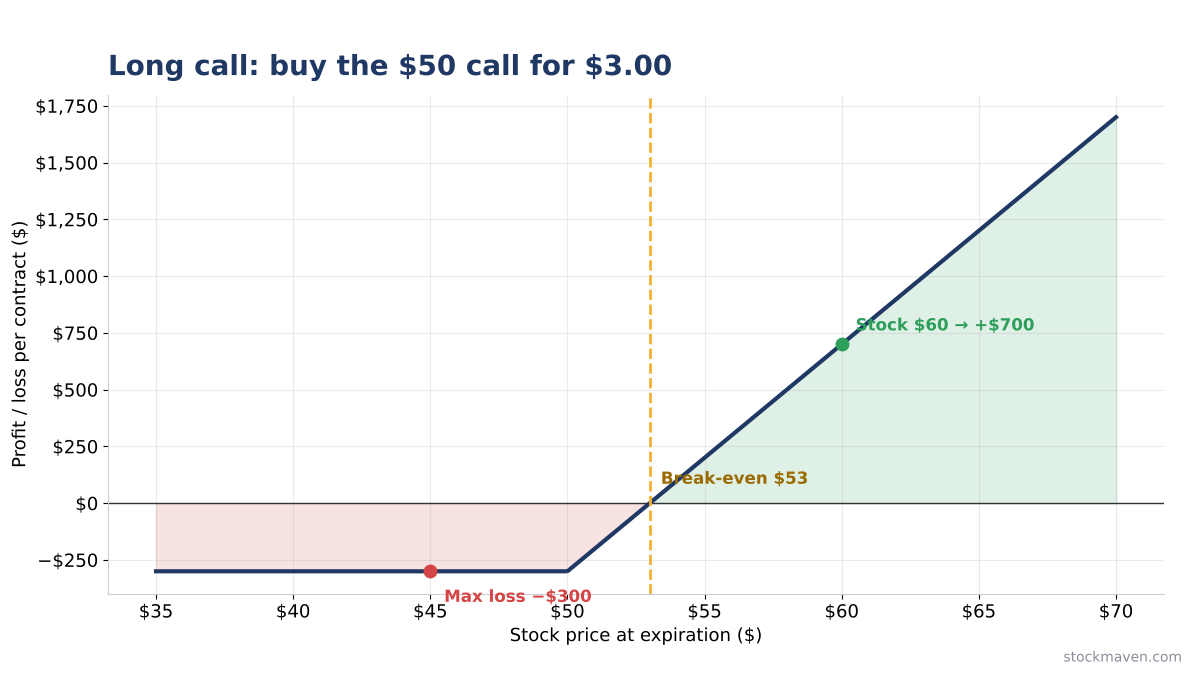
Buying the 100 shares instead would have cost $5,000 and made $1,000 on the same move, a 20% return. That’s leverage at work, in both directions.
When to use it: you expect a meaningful move up within a specific timeframe. Beginner tips: buy more time than you think you need (45+ days), and prefer strikes at or slightly in the money. The cheap far-OTM calls are cheap because they usually expire worthless.
2. Long put: profit from a drop, or insure your stock
Buying a put gains value as the stock falls. Traders use puts two ways: as a bearish bet, or as insurance on shares they already own (a protective put).
Example. A stock trades at $80. You buy the $80 put expiring in 45 days for $4.00 ($400).
- Break-even at expiration: $76 ($80 strike − $4 premium).
- If the stock falls to $70: the put is worth $10 ($1,000). Profit: $600.
- If the stock stays at $80 or rises: the put expires worthless. Loss: $400.
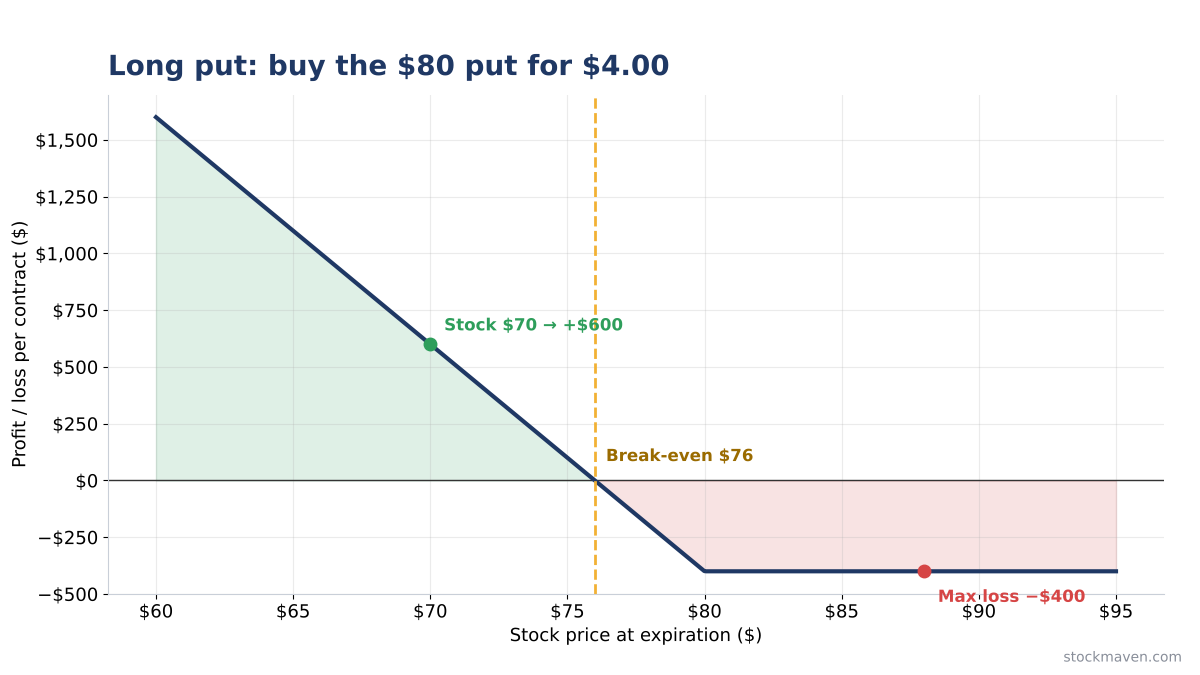
As insurance: if you own 100 shares at $80, that same put guarantees you can sell at $80 until expiration. Your worst case becomes a $400 loss (the premium), no matter how far the stock falls. Puts are a cleaner hedge than shorting; compare with how to short stocks on Robinhood and our how to hedge stocks guide.
Beginner tip: puts get expensive when fear is high. In November 2026, with the VIX near 28, hedges cost noticeably more than in calm markets, so buy protection before the storm when you can.
3. Covered call: earn income on stock you already own
If you own at least 100 shares, you can sell one call against them and collect the premium as income. In return, you agree to sell your shares at the strike price if the stock rises above it.
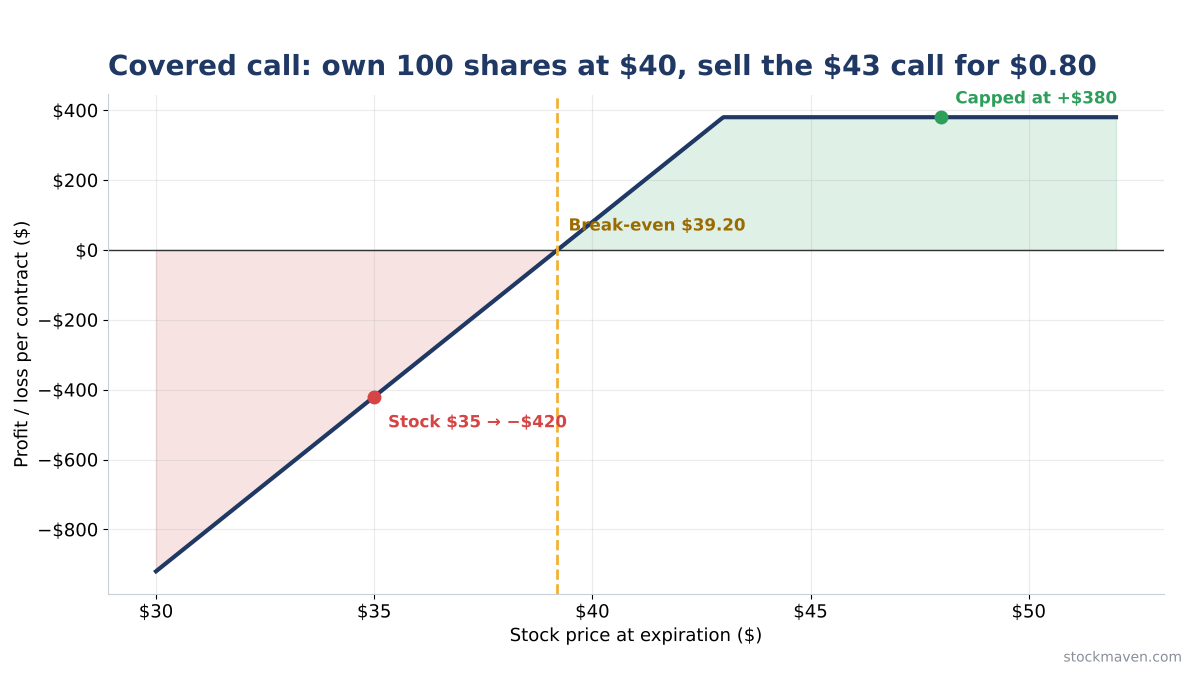
Example. You own 100 shares bought at $40. You sell one $43 call expiring in 30 days for $0.80 and collect $80 immediately.
- If the stock stays below $43: the call expires worthless. You keep the $80 and your shares, then sell another call next month. That’s 2% income in a month.
- If the stock rises to $50: your shares are “called away” at $43. You earn $300 on the shares plus $80 premium = $380. But you miss the gain above $43, which is the main trade-off.
- If the stock falls to $35: you lose $500 on the shares, cushioned slightly by the $80 premium.
When to use it: on stocks you’re happy to hold long term but don’t expect to soar soon. Pair it with dividend stocks for two income streams; see what are income stocks. Beginner tips: sell 30–45 days out at a strike you’d be glad to sell at, often delta 0.20–0.30. Avoid selling calls right before earnings, when a big jump could take your shares cheaply. Full guide: covered calls for beginners.
4. Cash-secured put: get paid to buy a stock cheaper
Selling a put obligates you to buy 100 shares at the strike if the stock falls below it. “Cash-secured” means you keep enough cash in the account to buy them. Think of it as a limit order that pays you while you wait.
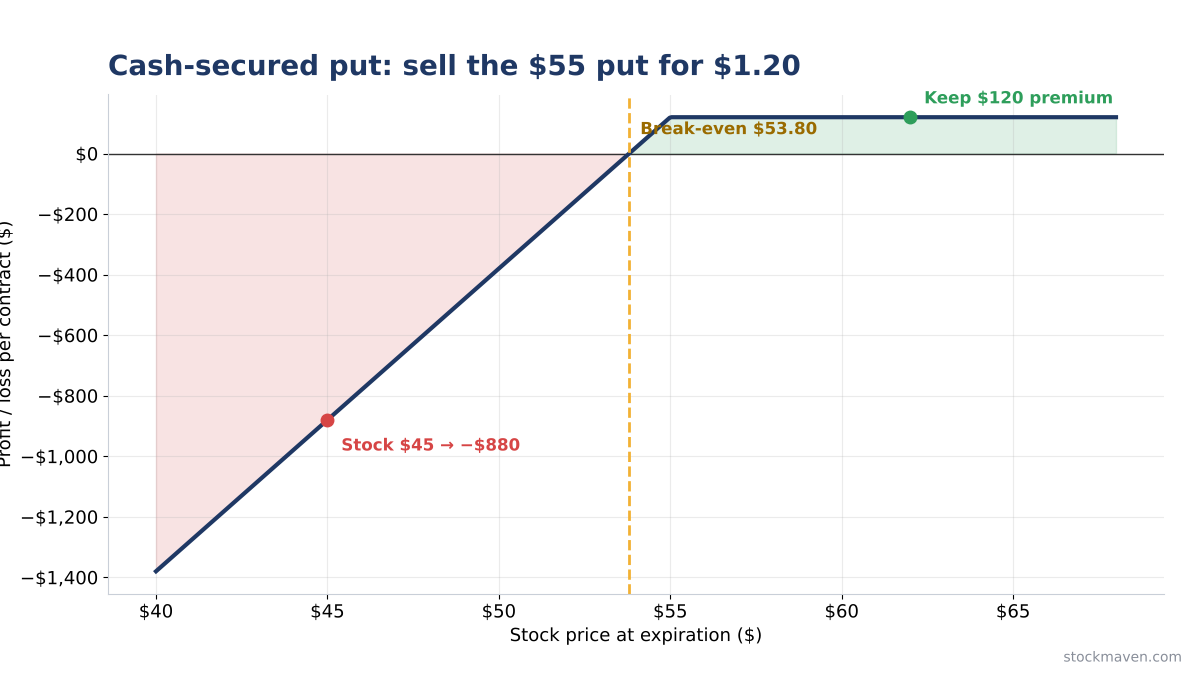
Example. A stock trades at $60 and you’d like to buy it at $55. You sell the $55 put expiring in 30 days for $1.20, collecting $120. Your broker sets aside $5,500.
- If the stock stays above $55: the put expires worthless. You keep $120, about 2.2% on the cash set aside in a month.
- If the stock dips to $54 at expiration: you’re assigned and buy 100 shares at $55. Your real cost is $53.80 per share after the premium, which is less than the price you wanted to pay.
- If the stock crashes to $45: you still must buy at $55. Your shares show an $880 paper loss ($53.80 − $45 = $8.80 × 100).
When to use it: only on stocks you genuinely want to own at that price. Beginner tip: never sell puts on a stock just because the premium is fat; a high premium usually means the market expects a big move. More in cash-secured puts explained.
5. Vertical spread: define your risk on both sides
A vertical spread combines buying one option and selling another of the same type and expiration at a different strike. Selling the second option lowers your cost but caps your profit. A bull call spread is the simplest version.
Example. A stock trades at $100. You buy the $100 call for $4.00 and sell the $105 call for $1.80, both expiring in 45 days. Net cost (debit): $2.20, or $220.
- Max loss: $220, if the stock finishes at or below $100.
- Max profit: $280 ($5 spread width − $2.20 debit), if the stock finishes at or above $105.
- Break-even: $102.20.
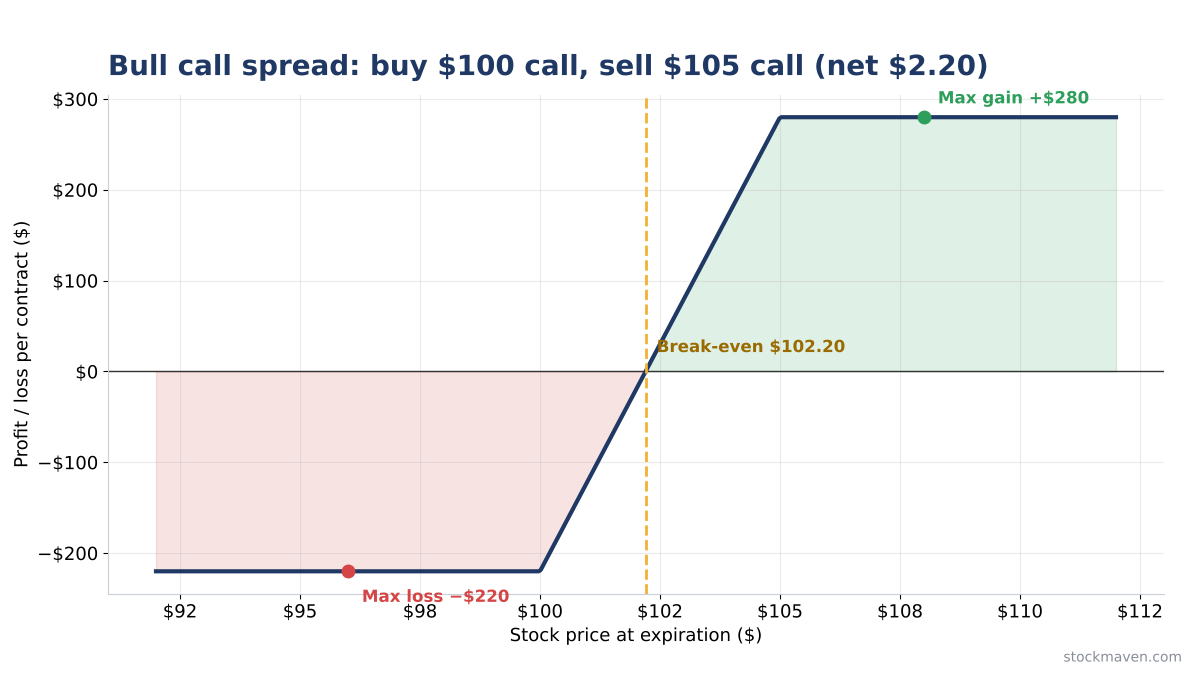
Compared with buying the $100 call alone for $400, the spread costs 45% less, needs a smaller move to break even, and suffers less from time decay and falling volatility. The price you pay is capped upside.
Flip it for a bearish view with a bear put spread: buy a higher-strike put, sell a lower-strike put. Our vertical spreads for beginners guide covers both, plus credit spreads.
Bonus: the wheel strategy
The wheel chains strategies 3 and 4 into a repeating income cycle:
- Sell a cash-secured put on a stock you want to own. Collect premium.
- If assigned, you now own 100 shares at a discount.
- Sell covered calls on those shares. Collect more premium.
- If the shares are called away, you’re back to cash. Start again at step 1.
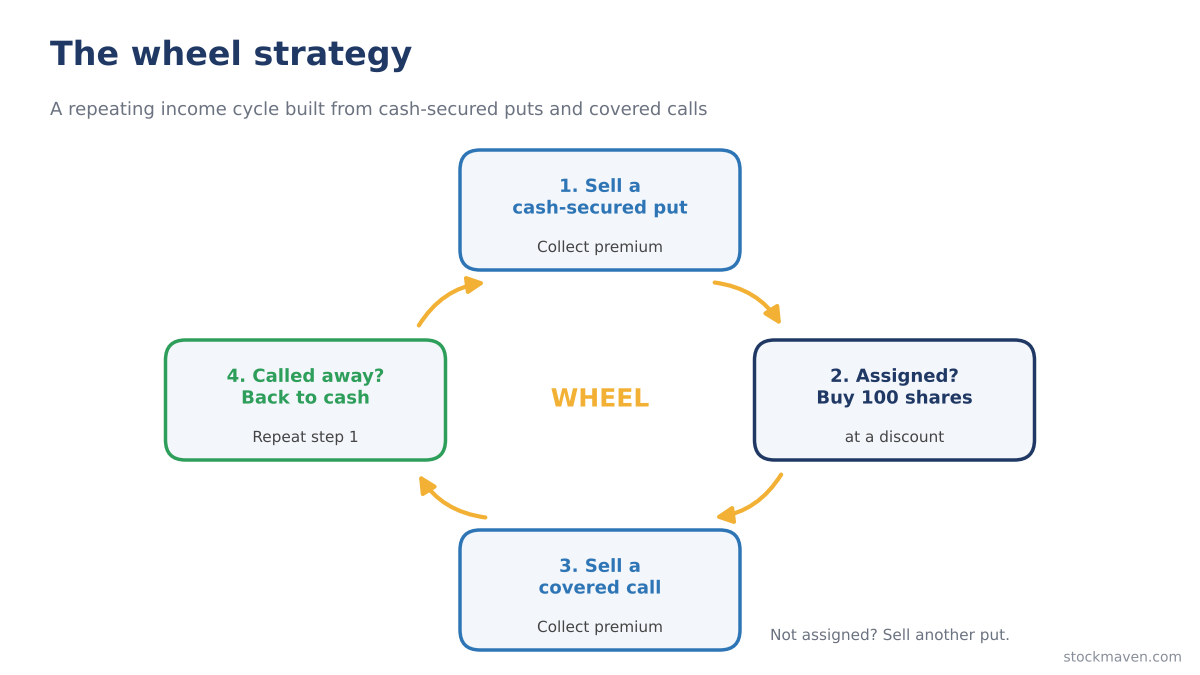
The wheel works best on stable, liquid stocks you’d happily hold through a downturn. Its weakness: in a sharp selloff you can end up holding shares worth far less than your strike while collecting only small call premiums. Read the wheel strategy explained for stock-selection rules and a full cycle example.
Implied Volatility: Why Options Get Expensive
Implied volatility (IV) is the market’s forecast of how much a stock will move, baked into the option’s price. Higher IV means more expensive options, for calls and puts alike. It’s the most important number beginners ignore.
What IV actually tells you
IV is quoted as an annual percentage. You can turn it into an expected move for any timeframe with a quick formula:
Expected move ≈ Stock price × IV × √(days ÷ 365)
For a $100 stock with 40% IV, the expected one-standard-deviation move over 30 days is about $100 × 0.40 × 0.287 = ±$11.50. The market is saying the stock will most likely finish between roughly $88.50 and $111.50.
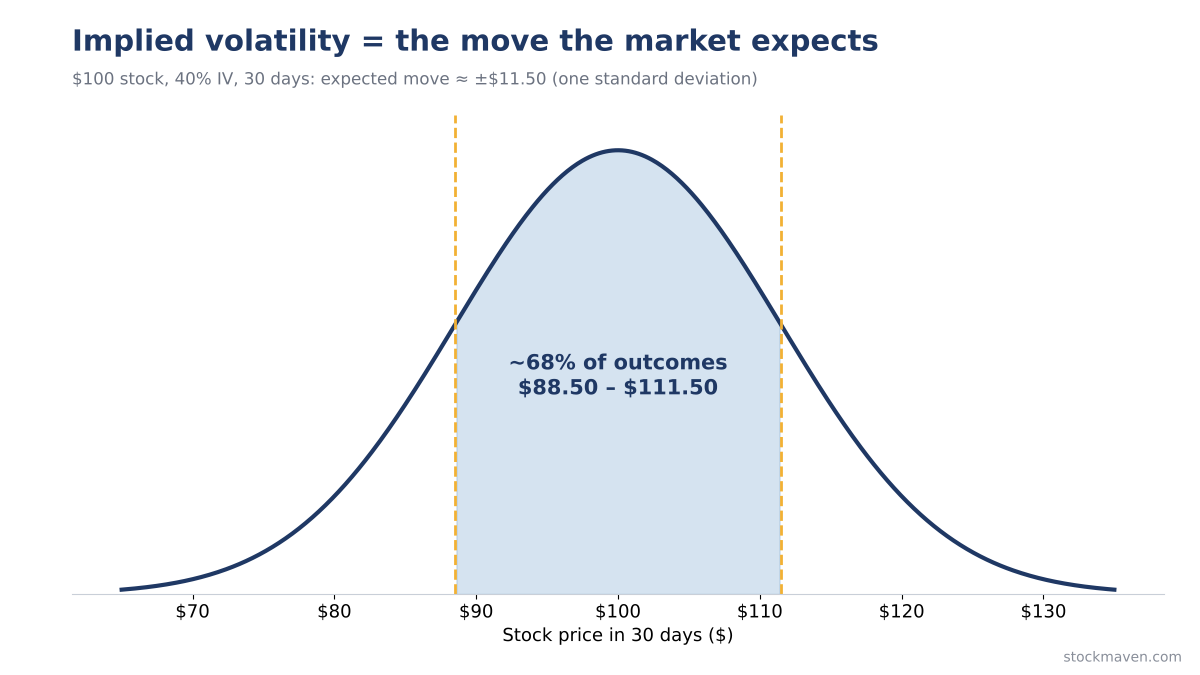
If you buy a call, you’re betting the stock moves more than that priced-in amount. If you sell options, you’re betting it moves less.
IV vs historical volatility
Historical volatility measures how much the stock has moved. Implied volatility measures how much the options market expects it to move. When IV is far above historical volatility, options are pricey relative to the stock’s track record, which favours sellers. When IV is low, options are cheap, which favours buyers.
IV rank and IV percentile
A raw IV of 35% means little on its own: that’s high for a utility stock and low for a biotech. IV rank compares today’s IV with the stock’s own 52-week range. An IV rank of 80 means IV sits near the top of its yearly range. Many traders sell premium when IV rank is high and buy options when it’s low. Most broker platforms show IV rank next to the chain.
IV crush: right direction, still lost money
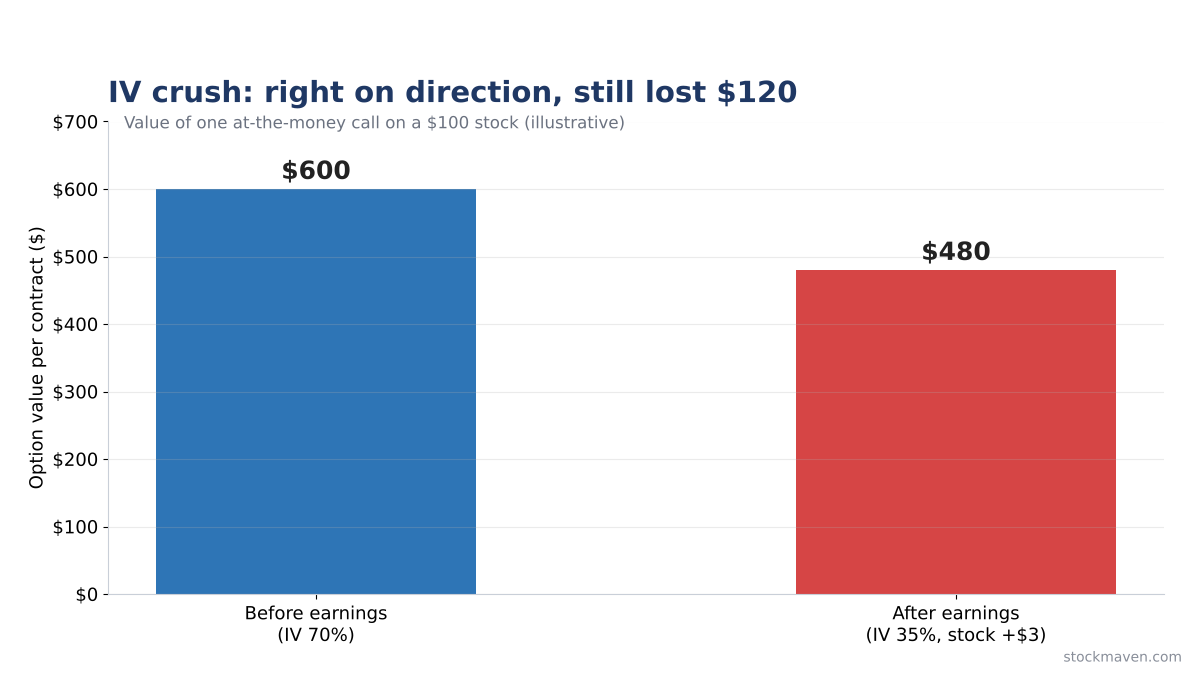
IV rises before known events such as earnings, FDA decisions and IPO options debuts, because a big move is possible. Once the news is out, uncertainty disappears and IV collapses. This is called IV crush.
Example. Before earnings, a $100 stock’s at-the-money call expiring in about two weeks costs $6.00 with IV at 70%. Earnings beat, and the stock rises $3. But IV drops to 35% overnight, and the call is now worth $4.80. You were right about direction and still lost $120 per contract.
New listings show this clearly. When Anthropic (ANT) options start trading after its November 19 IPO, expect very high IV at first, because nobody knows yet how volatile the stock will be. IV typically settles as the stock builds a trading history.
The VIX connection
The VIX is the implied volatility of S&P 500 options, often called the market’s “fear gauge”. When the VIX jumps, IV rises across most stocks too. In November 2026 the VIX closed at 28.44 on November 19, up about 52% in a week, so options on nearly everything cost more than usual. Our market volatility strategies guide covers how to position for these periods.
How beginners should use IV
- Check IV rank before every trade. High IV rank favours selling (covered calls, cash-secured puts, credit spreads). Low IV rank favours buying calls, puts and debit spreads.
- Avoid buying options right before earnings unless you specifically expect a move bigger than the one priced in.
- Use spreads when IV is high. Selling one leg offsets part of the inflated price you pay for the other.
Full guide: implied volatility explained.
How Much Money Do You Need?
One of the first questions in options trading for beginners is how much cash it really takes. You can technically buy one option for under $100, but a realistic starting account is $2,000–$5,000. That’s enough to trade small, diversify a little, and survive a few losing trades while you learn.
| Account size | What you can realistically do |
|---|---|
| Under $500 | Buy single calls/puts on lower-priced stocks; one losing trade is a big share of the account. Paper trade instead. |
| $2,000 | Margin account minimum at most brokers: unlocks spreads. Cash-secured puts on stocks under ~$20. |
| $5,000–$10,000 | Covered calls on 100 shares of a moderately priced stock, cash-secured puts up to a ~$50 strike, several small spreads. |
| $25,000+ | The wheel on blue-chip stocks, more diversification, larger spreads. |
The day-trading rule changed in 2026. The old “pattern day trader” rule required $25,000 in a margin account if you made four or more day trades in five business days. In April 2026 the SEC approved FINRA’s replacement of that rule with new intraday margin standards, effective June 4, 2026. The PDT designation and the $25,000 minimum are gone, though brokers may phase in the new rules during a transition period. Check your broker’s current policy.
Position-sizing rule: risk no more than 1–2% of your account on any single trade. On $2,000, that’s $20–$40 per trade, which is why spreads and paper trading matter so much at the start. See how to invest with $500 if you’re starting very small, and read how much money do you need to trade options for a full breakdown.
Risks, Taxes & Rules to Know
No guide to options trading for beginners is complete without the less exciting part. Options reward people who understand the rules and punish people who learn them the hard way. This section covers the risks, the mechanics of expiration and assignment, and how options are taxed in the US.
The 7 main risks
- You can lose 100% of the premium. When you buy an option, it can expire worthless. Unlike a stock, which may recover, an expired option is gone for good.
- Leverage cuts both ways. A 5% stock move can mean a 50% gain or a 50% loss in the option. Size positions as if the worst case will happen.
- Time decay never stops. Every day, an option buyer’s position loses some time value, including weekends and holidays. The decay speeds up in the final 30 days.
- Volatility can work against you. If implied volatility falls, your option loses value even if the stock doesn’t move (see IV crush above).
- Liquidity and wide spreads. On thinly traded options, the gap between bid and ask can cost you 10% or more on entry and exit combined.
- Gap risk. Stocks can jump overnight on earnings or news. Stop-loss orders don’t protect you from a gap, and option prices can open far from where they closed.
- Some selling strategies have very large or unlimited risk. Selling a call without owning the shares (a naked call) has theoretically unlimited loss. This is why brokers restrict it to the highest approval level. Beginners should only sell options that are covered by shares or cash.
Before approving you, your broker must give you the Options Clearing Corporation’s disclosure document, Characteristics and Risks of Standardized Options. Read it, at least the sections on the strategies you plan to use.
Expiration rules
- When options expire: standard monthly options expire on the third Friday of the month. Many stocks and ETFs also have weekly expirations, and the most active ETFs like SPY and QQQ have expirations every trading day.
- Trading hours: expiring stock and ETF options stop trading at 4:00 PM ET on expiration day. On early-close days, such as the day after Thanksgiving, options exchanges close at 1:00 PM ET, which also moves the exercise cut-off.
- Automatic exercise: an option that finishes at least $0.01 in the money is usually exercised automatically by the Options Clearing Corporation. If you own an in-the-money call at expiration and don’t have the cash to buy 100 shares, your broker may close it for you, or you could end up with a margin call.
- Settlement: options trades settle the next business day (T+1). Learn why that matters in what are unsettled funds in Robinhood.
- Index options are different. Options on indexes such as SPX are cash-settled and European-style (exercisable only at expiration), so there’s no share delivery.
Beginner rule: close or roll your positions before expiration day. Holding into the final hours adds gamma risk and assignment surprises for very little extra profit.
Assignment: when you’re on the selling side
If you sell an option, the buyer can exercise it and you get assigned: you must deliver shares (on a call) or buy shares (on a put) at the strike price.
- Most US stock options are American-style, so the buyer can exercise any time before expiration, not just on the last day.
- Early assignment is rare but real. It’s most likely when an option is deep in the money with little time value left, or on a call the day before a stock’s ex-dividend date, when the buyer wants the dividend.
- Assignment on a covered call or cash-secured put isn’t a disaster, because you already planned for it. That’s exactly why beginners should sell only covered options.
How options are taxed in the US
Options are generally taxed as capital gains, but the details depend on what happened to the contract. This is general information, not tax advice; talk to a tax professional about your situation.
| What happened | Tax treatment (typical) |
|---|---|
| You bought an option and sold it | Capital gain or loss; short-term if held one year or less (most options) |
| You bought an option and it expired worthless | Capital loss on the expiration date |
| You sold an option and it expired | The premium is a short-term capital gain |
| You sold a covered call and were assigned | Premium is added to your sale price of the shares |
| You sold a put and were assigned | Premium reduces the cost basis of the shares you bought |
| Broad-based index options (e.g., SPX) | Section 1256: 60% long-term / 40% short-term, marked to market at year-end |
Three more rules to know:
- Short-term gains are taxed as ordinary income. Because most options are held for weeks, most profits are short-term.
- The wash-sale rule applies to options. Selling a stock at a loss and buying a call on the same stock within 30 days can disallow the loss.
- Your broker reports trades on Form 1099-B. Check when your forms arrive; for example, see when Robinhood tax documents are available.
Outside the US? Rules differ. In Canada, for example, options gains may be treated as capital gains or business income depending on how actively you trade, and US rules like Section 1256 don’t apply.
Rules your broker enforces
- Approval levels limit which strategies you can use (see above).
- Margin requirements apply to spreads and to any option selling beyond covered positions.
- Day trading: the $25,000 pattern-day-trader rule was replaced in June 2026, but brokers can still set their own intraday margin limits.
For a broader framework on protecting your capital, read our risk management strategies guide.
Options Trading for Beginners: 10 Mistakes to Avoid
Most beginner losses come from the same handful of mistakes, and every one of them is avoidable. Here are the ten we see most often.
- Buying cheap far-out-of-the-money options. A $0.10 call feels like a lottery ticket with little to lose, and it usually pays like one. These options need a huge move in a short time. Buy strikes closer to the money and give yourself time.
- Ignoring implied volatility. Buying options when IV is high, especially before earnings, means overpaying. Even a correct call can lose money after IV crush. Check IV rank before every trade.
- Trading without an exit plan. Decide your profit target, your maximum loss and your time stop before you enter. Without a plan, fear and hope make the decision for you.
- Position sizes that are too big. One bad trade shouldn’t wreck your account. Keep each trade’s risk to 1–2% of your account. Five losing trades in a row is normal, so make sure you can survive them.
- Holding into expiration. The final days bring the fastest time decay and the wildest gamma swings. Close or roll at least a few days before expiry unless you want to be exercised or assigned.
- Being surprised by assignment. If you sell options, assume you may be assigned at any time, especially when the option is deep in the money or before an ex-dividend date. Only sell options you can fully cover with shares or cash.
- Trading illiquid strikes. Wide bid-ask spreads quietly eat your profits. Stick to strikes with tight spreads and open interest in the hundreds or more, and always use limit orders.
- Jumping straight into 0DTE options. Same-day options are hugely popular, but they move extremely fast and can go to zero within hours. Learn on 30–60-day options first. See is day trading good for beginners for the same lesson in stocks.
- Revenge trading. After a loss, the urge to win it back immediately leads to bigger, riskier trades. Take a break after two losses in a row. Our article on why day traders fail covers the psychology, and how day traders lose money shows the math.
- Forgetting about taxes and fees. Short-term gains are taxed as ordinary income, and per-contract fees add up with frequent trading. Track your results after costs, not before.
The pattern behind them all: treating options like a fast way to get rich instead of a tool with defined rules. Slow down, trade small, and write everything down. Many of the same traps appear in our list of costly investing mistakes.
Read the full breakdown, with a printable pre-trade checklist, in 10 options trading mistakes beginners make.
Options Trading for Beginners: Glossary of Key Terms
Bookmark this list. These are the terms you’ll meet most often on an options chain, an order ticket or a trading forum, each defined in one or two plain sentences.
| Term | Meaning |
|---|---|
| American-style option | An option that can be exercised any day before expiration. Most US stock and ETF options are American-style. |
| Ask | The lowest price a seller is willing to accept. You typically buy at or near the ask. |
| Assignment | When the seller of an option is required to fulfil the contract: deliver shares (call) or buy shares (put) at the strike. |
| At the money (ATM) | An option whose strike is at or very near the current stock price. |
| Bear put spread | Buying a higher-strike put and selling a lower-strike put to profit from a moderate drop with limited risk. |
| Bid | The highest price a buyer is willing to pay. You typically sell at or near the bid. |
| Bid-ask spread | The gap between bid and ask. Narrow spreads mean a liquid option; wide spreads cost you money. |
| Break-even | The stock price at which your trade neither gains nor loses at expiration, after the premium. |
| Bull call spread | Buying a lower-strike call and selling a higher-strike call to profit from a moderate rise with limited risk. |
| Call option | A contract giving the buyer the right to buy 100 shares at the strike price before expiration. |
| Cash-secured put | Selling a put while holding enough cash to buy the shares if assigned. |
| Contract | One option, normally covering 100 shares of the underlying. |
| Covered call | Selling a call against 100 shares you already own to collect premium. |
| Credit spread | A spread where you collect more premium than you pay, so you receive money up front. |
| Debit spread | A spread where you pay more premium than you collect, so it costs money up front. |
| Delta | How much an option’s price changes for a $1 move in the stock. Also a rough probability of finishing in the money. |
| Derivative | A financial contract whose value is derived from another asset, like a stock or index. |
| DTE (days to expiration) | The number of days until an option expires. 0DTE means it expires today. |
| European-style option | An option that can only be exercised at expiration. Most index options, like SPX, are European-style. |
| Exercise | Using your right as the option buyer to buy (call) or sell (put) the shares at the strike. |
| Expiration date | The last day an option exists. After it, the contract is either exercised or worthless. |
| Extrinsic value | The part of an option’s price beyond its intrinsic value, made up of time value and volatility. Also called time value. |
| Gamma | How fast delta changes as the stock moves. Highest for at-the-money options near expiration. |
| Greeks | Delta, gamma, theta, vega and rho: measures of how an option’s price reacts to changes in the market. |
| Hedge | A position that offsets risk in another position, like buying a put to protect shares you own. |
| Implied volatility (IV) | The market’s expected future volatility, built into the option’s price. Higher IV means pricier options. |
| In the money (ITM) | A call with a strike below the stock price, or a put with a strike above it. It has intrinsic value. |
| Intrinsic value | How much an option would be worth if exercised right now. Out-of-the-money options have zero. |
| Iron condor | A neutral strategy combining a bull put spread and a bear call spread, profiting if the stock stays in a range. |
| IV crush | A sharp drop in implied volatility after an event like earnings, which lowers option prices. |
| IV rank | Where today’s IV sits within its range over the past year, from 0 to 100. |
| Leg | One option within a multi-option strategy. A vertical spread has two legs. |
| Limit order | An order to buy or sell at a specific price or better. Always use limit orders for options. |
| Long | Owning a position. A long call means you bought a call. |
| Moneyness | Where the strike sits relative to the stock price: ITM, ATM or OTM. |
| Open interest | The number of contracts still open. Higher open interest usually means better liquidity. |
| Out of the money (OTM) | A call with a strike above the stock price, or a put with a strike below it. No intrinsic value. |
| Paper trading | Simulated trading with fake money on real market data. Ideal for learning. |
| Premium | The price of an option, quoted per share. Multiply by 100 for the cost of one contract. |
| Protective put | Buying a put on shares you own to limit downside, like insurance. |
| Put option | A contract giving the buyer the right to sell 100 shares at the strike price before expiration. |
| Rho | How much an option’s price changes with interest rates. Usually minor for short-term trades. |
| Roll | Closing an option and opening a similar one with a later expiration or different strike. |
| Short | Having sold a position. A short put means you sold a put and collected premium. |
| Strike price | The price at which the option lets you buy or sell the underlying. |
| Theta | How much value an option loses each day from time decay. |
| Time decay | The steady loss of an option’s time value as expiration approaches. |
| Underlying | The stock, ETF or index an option is based on. |
| Vega | How much an option’s price changes for a 1-point change in implied volatility. |
| Vertical spread | Buying and selling options of the same type and expiration at different strikes. |
| Wheel strategy | Repeatedly selling cash-secured puts, then covered calls after assignment, to generate income. |
Want all of these on one page? Get the printable version in our options trading terms glossary.
Free Tool: Options Profit Calculator
Before you place any trade, know your break-even, maximum profit and maximum loss. Our free options profit calculator does the math for you: enter the stock price, strike, premium and number of contracts, and it shows your profit or loss at different prices on expiration day.
It works like our other free tools, such as the stock average calculator and stock basis calculator. Use it on every practice trade until the numbers become second nature.
Options Trading for Beginners: FAQ
Is options trading good for beginners?
It can be, if you start with defined-risk strategies and small sizes. Covered calls, cash-secured puts and vertical spreads are reasonable first steps. Buying short-dated, far out-of-the-money options is not.
Can you lose more money than you invest in options?
When you buy calls or puts, the most you can lose is the premium you paid. Some selling strategies, especially naked calls, can lose far more than you collected. Beginners should only sell options that are covered by shares or cash.
Can I trade options with $100?
You can buy a single cheap option with $100, but one losing trade wipes out a large share of your account. Paper trade until you have $2,000 or more to work with.
How long does it take to learn options trading?
Most people can learn the basics in a few weeks. Becoming consistently profitable usually takes months of practice and a written trading plan.
Are options better than stocks?
Neither is better; they do different jobs. Stocks build long-term wealth simply. Options add leverage, income and hedging, but with more complexity and time pressure.
What is the safest options strategy?
Covered calls on stocks you already own are generally considered the lowest-risk options strategy. The option adds income without adding downside beyond owning the stock.
Do I need a margin account to trade options?
Not for buying calls and puts, covered calls or cash-secured puts. Spreads and most other selling strategies require a margin account.
What happens if my option expires in the money?
It is usually exercised automatically. A long call becomes 100 shares you must pay for; a long put sells 100 shares you must own or borrow. Close the position before expiration to avoid surprises.
Next Steps
You now know more than most people do before they place their first trade, and that’s the real point of options trading for beginners: learn the rules before you risk the money. Here’s what to do this week:
- Open a paper trading account and place five practice trades using the strategies above.
- Pick one strategy, probably the covered call or cash-secured put, and learn it deeply before adding another.
- Only then go live, with one small trade that risks under 2% of your account.
Options involve risk and are not suitable for all investors. Before trading options, read Characteristics and Risks of Standardized Options. This article is for educational purposes only and is not investment, tax or legal advice. Examples are hypothetical and exclude commissions and fees.
Sources
- Anthropic starts trading in the US after blockbuster IPO: Al Jazeera, Nov 19, 2026
- Anthropic options set to begin trading Monday as Cboe expects heavy demand: Nov 2026
- Wall Street’s fear index just hit 9.7 (VIX close of 28.44 on Nov 19): 24/7 Wall St., Nov 21, 2026
- FINRA Information Notice 11/16/26: Thanksgiving early close
- FINRA weekly update: new intraday margin standards replace the PDT rule, effective June 4
- Investor.gov: pattern day trader
- E*TRADE: pattern day trading rule change

That is why I made my site - Stock Maven. Now that I feel settled and confident about trading, I want to be a source of help to anyone else who might be struggling to break into the crypto market successfully.
My website is full of my tips and tricks, as well as information that I have always found interesting about crypto. My friends and family are sick of hearing me talk about it, so now it’s your turn!
I hope that you stick around and find something useful on my site. Remember, to make it big in crypto, you’ve got to be confident! Go for it and don’t look back.
- Options Trading for Beginners: The Complete 2026 Guide - November 23, 2026
- Quantum AI Stocks: Best Companies to Watch in 2026 - September 16, 2026
- IonQ vs Rigetti vs D-Wave: Which Is the Best Stock Buy? - September 15, 2026